


Darod

Os Darod (em somali: Daarood, em árabe: دارود) é um clã somali. O pai deste clã é nomeado Abdirahman bin Ismail al-Jabarti, porém é mais comumente conhecido como Darod. Na língua somali, a palavra "Daarood" significa "composto fechado", uma fusão de duas palavras Daar (composto) e ood (lugar fechado por muro, árvores, madeiras, cercas, etc.)
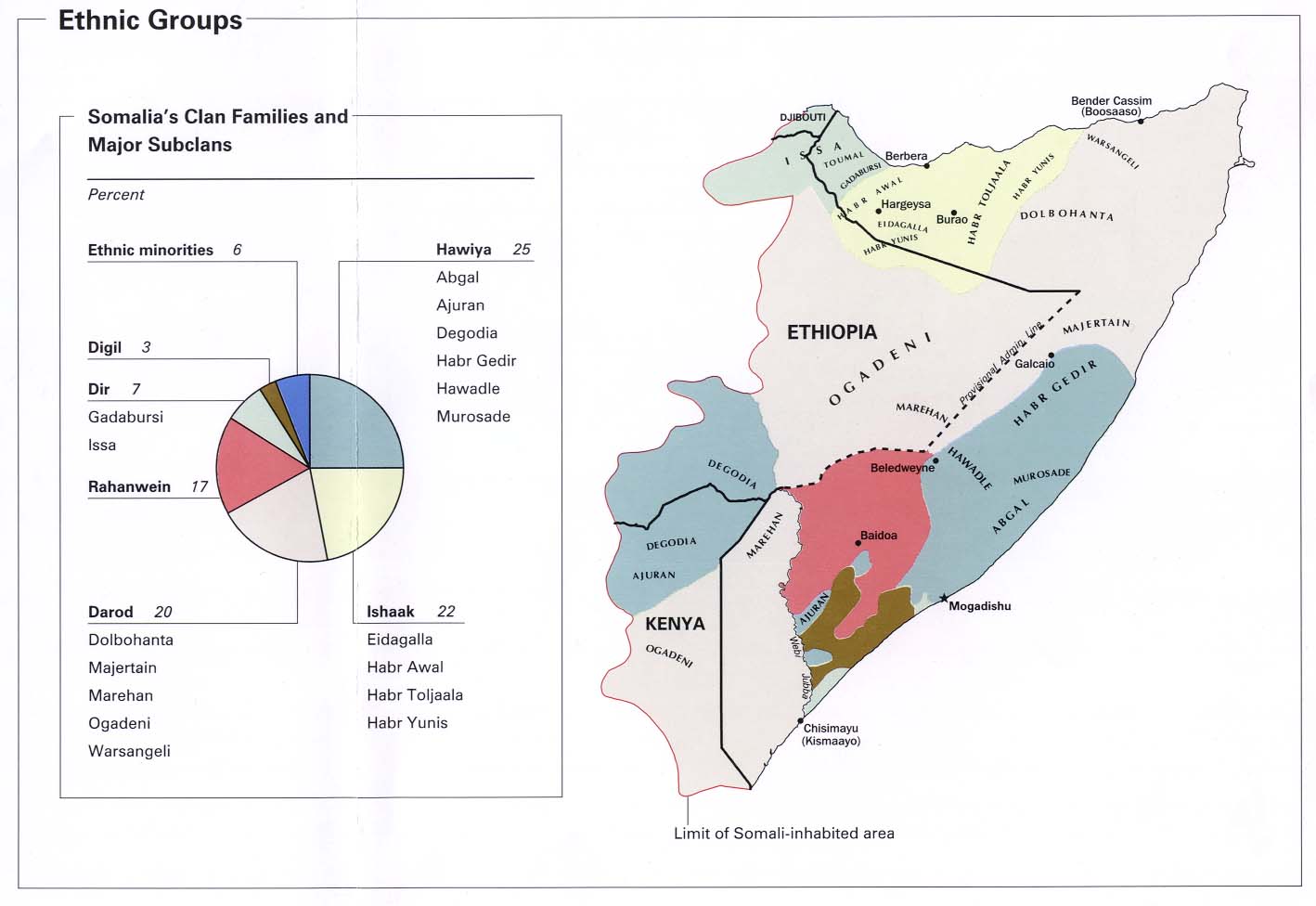
A população Darod na Somália vive principalmente no norte, com presença em Kismayo, além da região do sudoeste de Gedo. Fora da Somália propriamente dita, existem vários sub-clãs Darod em Ogaden e na Província do Nordeste (atualmente administradas pela Etiópia e Quênia, respectivamente), bem como no Iêmen. Diversas fontes, incluindo o Relatório da Comissão Canadense de Inquérito sobre a Somália, indicam que os Darod são o maior clã somali .[1][2] No entanto, outras fontes, como a CIA e a Human Rights Watch indicam que os Hawiye são o maior clã da Somália.[3][4]
Árvore do clã[editar | editar código-fonte]
Não há nenhum acordo claro sobre o clã e as sub-estruturas do clã e muitas linhagens são omitidas. A lista a seguir é baseada em Conflict in Somalia: Drivers and Dynamics de 2005 do Banco Mundial e na publicação do Home Office do Reino Unido , Somalia Assessment 2001.[5][6]
- Darod (Daarood)
- Geri Kombe[7][8][9][10]
- Marehan
- Red Dini
- Rer Hassan
- Eli Dheere
- Kabalah
- Absame
- Harti
- Dhulbahante (Dolbahante)
- Warsangali (Warsengeli)
- Majeerteen (Mijerteen)
- Omar Mahmud
- Issa Mahmud
- Osman Mahmoud (Osman Mahmud)
David D. Laitin e Said S. Samatar oferecem um quadro um pouco diferente:[11]
- Darod (Daarood)
Na parte sul central da Somália o Banco Mundial mostra a árvore de clãs a seguir:[12]
Em Puntland, o Banco Mundial revela o seguinte:[13]
- Darod
- Harti
- Ogaden
- Marehan
- Awrtable
- Lelkase
Uma tradição afirma que Darod teve uma filha.[14]
Notas[editar | editar código-fonte]
- ↑ «The Situation in Somalia». Report of the Somali Commission of Inquiry, Vol. 1. Consultado em 21 de novembro de 2005. Arquivado do original em 12 de novembro de 2005
- ↑ Somalia Assessment 2001, Annex B: Somali Clan Structure, Country Information and Policy Unit, Home Office, Great Britain, Retrieved 2020-06-20
- ↑ Central Intelligence Agency (2002). «Ethnic Groups». Somalia Summary Map. Consultado em 15 de fevereiro de 2006
- ↑ Human Rights Watch (1990). «Somalia: Human Rights Developments». Human Rights Watch World Report 1990. Consultado em 21 de novembro de 2005
- ↑ Worldbank, Conflict in Somalia: Drivers and Dynamics, January 2005, Appendix 2, Lineage Charts, p.55
- ↑ Country Information and Policy Unit, Home Office, Great Britain, Somalia Assessment 2001, Annex B: Somali Clan Structure, p. 43
- ↑ Proceedings of the Royal Geographical Society and monthly record ..., Volume 6 page 260-261. By Royal Geographical Society (Great Britain)
- ↑ «African tribal Names». Consultado em 23 de outubro de 2011. Arquivado do original em 7 de outubro de 2011
- ↑ Ethnographie Nordost-Afrikas ... By Philipp Paulitschke
- ↑ Genealogical Table of Somali Clans
- ↑ Laitin and Samatar, Somalia: Nation in Search of a State (Boulder: Westview, 1987), p. 32
- ↑ Worldbank, Conflict in Somalia: Drivers and Dynamics, January 2005, Appendix 2, Lineage Charts, p.56 Figure A-2
- ↑ Worldbank, Conflict in Somalia: Drivers and Dynamics, January 2005, Appendix 2, Lineage Charts, p.57 Figure A-3
- ↑ Laurence, Margaret (1970). A Tree for Poverty: Somali Poetry and Prose. Hamilton: McMaster University. p. 145. ISBN 1550221779.
Then Magado, the wife of Ishaak, bore him twin sons, and their names were Ahmed, nick-named Arap, and Ismail, nick-named Gerhajis.
Referências[editar | editar código-fonte]
- Hunt, John A. (1951). "Chapter IX: Tribes and Their Stock". A General Survey of the Somaliland Protectorate 1944–1950. London: Crown Agent for the Colonies. Accessed on October 7, 2005 (from Civic Webs Virtual Library archive).
- «The Somali Ethnic Group and Clan System». Civic Webs Virtual Library, from: Reunification of the Somali People by Jack L. Davies, Band 160 IEE Working Papers, Institute of Development Research and Development, Ruhr-Universität Bochum, Bochum, Germany 1996, ISBN 3-927276-46-4, ISSN 0934-6058. Consultado em 22 de janeiro de 2006. Arquivado do original em 21 de setembro de 2002